In this guide
- Stan’s take: why DiscoLike is our pick for a wider target market
- The use cases and features that matter to us
- A practical play: uncover a niche your current database misses
- How DiscoLike search works
- How to evaluate discovery quality
- DiscoLike pricing and usage planning
- DiscoLike versus other parts of a GTM stack
- Limitations and an operating procedure
- DiscoLike implementation with frontBrick
- DiscoLike buyer questions
Stan’s take: why DiscoLike is our pick for a wider target market
DiscoLike is my preferred tool when we need to build a total addressable market beyond the companies that are easy to find on LinkedIn. Many relevant businesses describe themselves better on their own websites than in a database category. That is where this approach becomes valuable.
The combination I like is company discovery, AI validation of whether a business fits, and contact discovery through ContaGen. We can use our own AI provider keys or the platform’s supported options, which gives us flexibility over how the research is run.
I would use it to expand and validate a market, not simply to export the largest possible list. The useful result is a set of companies we can explain and prioritize, followed by the people who make sense for the campaign.
The use cases and features that matter to us
| Use case | Feature | Why we use it |
|---|---|---|
| Build a market beyond LinkedIn | Website-based company discovery | Find businesses through what they actually sell and the customers they serve. |
| Expand from good-fit customers | Lookalikes and natural-language search | Discover adjacent companies without relying on one industry label. |
| Check whether an account belongs | AI ICP validation | Review company fit against the offer before investing in contact research. |
| Find people at accepted accounts | ContaGen contact discovery | Extend the workflow from company discovery into finding relevant contacts. |
| Choose the research setup | Bring-your-own model and search options | Use the supported providers that fit your operating approach. |
Feature references: DiscoLike ContaGen contact discovery; DiscoLike supported plans and provider options.
A practical play: uncover a niche your current database misses
Here is a practical way to apply that approach to your own team:
- Describe the business activity, customer type and exclusions that define your ideal account.
- Search the web-based company universe and compare a sample against known good-fit customers.
- Validate the business model with AI-supported research, retaining the reason each company qualifies.
- Use ContaGen for relevant contact discovery, then enrich the accepted people and build outreach around the company evidence.
How DiscoLike search works
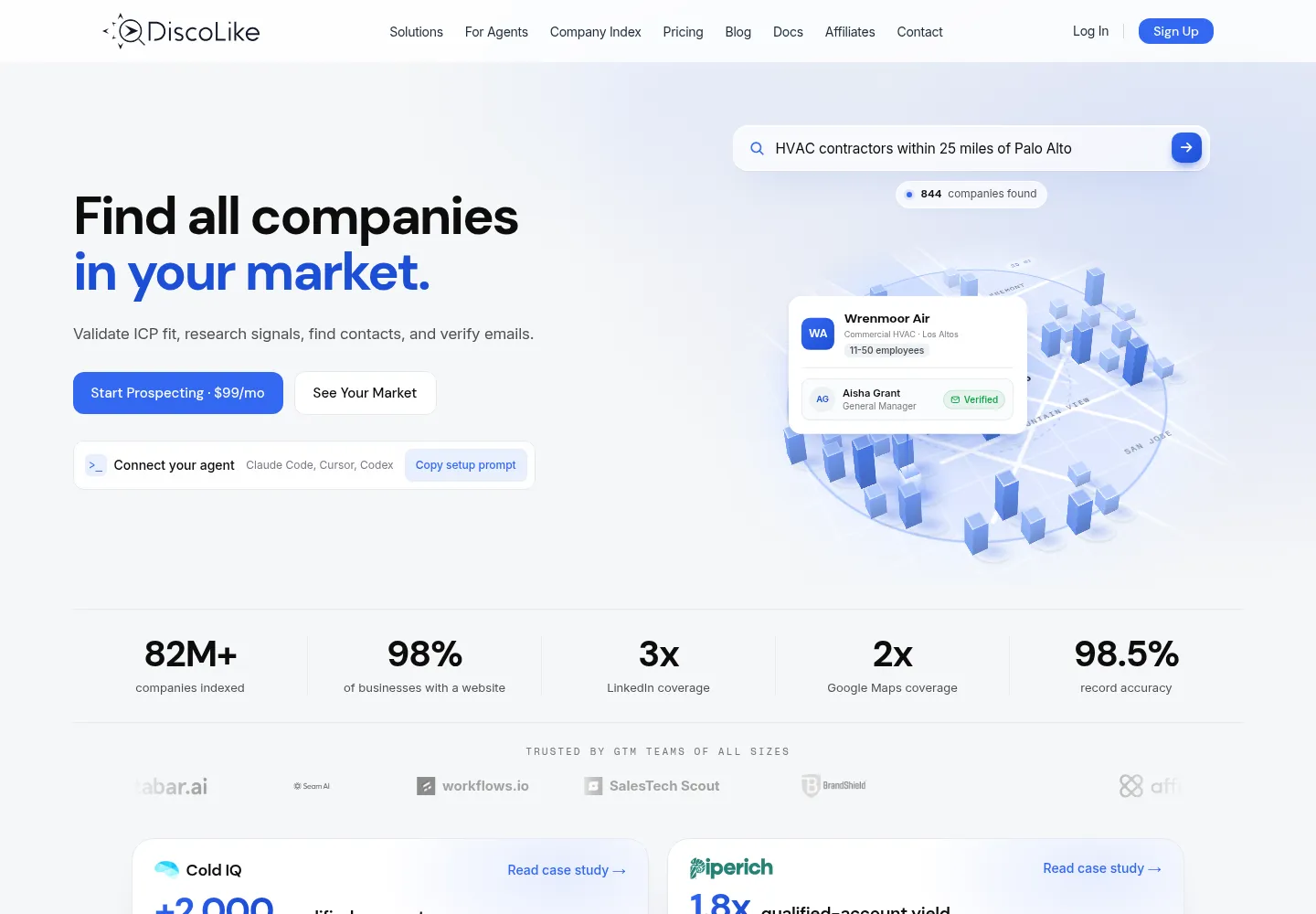
The Discover API supports domain lookalikes, natural-language ICP descriptions, structured filters and website phrase matching. You can supply positive examples and negative descriptions to separate businesses that look similar but sell something different. Search results provide company profiles ranked by relevance.
The Count API lets you inspect result volume before retrieving a full list. That is helpful when a query is too broad or a geographic filter removes most of the market. A count is still a database result, not a verified estimate of every company in your total addressable market.
The wider platform includes company enrichment, contacts, name-to-domain matching and relationship data. Technical teams can use the API, Python SDK, CLI or MCP integration. Choose the interface your team can maintain; the quality of the targeting brief matters more than whether a person or an agent submits it.
How to evaluate discovery quality
Keep a holdout list of known good-fit companies that were not used as seeds. Check whether the search can surface them, but do not treat missing one as proof the whole database is poor. Try alternative descriptions that reflect the vocabulary those companies use.
Review both strong and weak matches. Assign rejection reasons such as wrong business model, unsupported territory, duplicate entity, insufficient evidence or too small. These labels tell you whether to change the query, the seed set or the offer.
Measure three distinct outcomes: accepted accounts divided by reviewed accounts, net-new accepted accounts after CRM exclusions, and qualified sales conversations from contacted accounts. A list can have excellent relevance but little incremental value if every account is already in your CRM.
For a fair comparison with another source, use the same geography, exclusions and acceptance criteria. Combine and deduplicate both outputs before calculating unique contribution. Raw list size is an unreliable winner-selection metric.
DiscoLike pricing and usage planning
Reviewed 18 October 2026: monthly plans are Starter $99, Pro $199, Team $399, Company $799 and Enterprise $1,599. Annual billing is discounted. The subscription funds usage credits; query submissions and new records consume that allowance at plan-specific rates.
Starter lists $0.18 per query and $3.50 per 1,000 new records. A new record is a company or contact not retrieved in the previous 90 days; retrieving it again inside that window is free under the stated policy. Unused credits can roll over up to one month's subscription value. Confirm the applicable charges for additional research operations before a large run.
Do not interpret an “up to” record allowance as guaranteed export capacity. Query charges also consume credits. Plan for exploration, accepted exports and refreshes separately, then add the cost of contact enrichment, orchestration and sales execution.
API and MCP access are included across plans. Customer-facing software embedding has separate plan requirements. Check those terms if your users will access the data through a product rather than your team using it internally.
DiscoLike versus other parts of a GTM stack
| Need | Tool to evaluate | Boundary |
|---|---|---|
| Discover companies from what their websites describe | DiscoLike | Validate relevance before finding contacts |
| Run repeatable company and people API searches | BlitzAPI | Compare coverage and returned-record economics on your market |
| Retrieve contact details for known people | Prospeo | Contact availability does not establish account fit |
| Combine discovery, enrichment and decision logic | Clay | Orchestration still needs a clear targeting brief |
| Read specific website pages for supporting evidence | Firecrawl | Extracted content must be checked and attributed |
You may need two of these layers, but you do not need every tool. Buy the missing capability and retain one accountable owner for the workflow.
Limitations and an operating procedure
Websites can be stale, multilingual, sparse or written to attract several audiences. A business mentioning a product may resell it rather than manufacture it. A large enterprise can look like your ideal customer while its relevant division is too small or inaccessible. These are qualification problems, not just search problems.
Save a query version, run date, normalized domain, evidence URL, decision and rejection reason. Review a sample whenever you change a seed or prompt. Set result and budget limits for agent-driven searches. For asynchronous jobs, retain the job ID and resume status checks rather than starting another paid job after a timeout.
Agree how often each segment needs refreshing. A stable manufacturing market may not need the same schedule as a rapidly changing software niche. Refresh based on the decision you need to make.
DiscoLike implementation with frontBrick
frontBrick can turn your market knowledge into a working discovery system: ICP brief, positive and negative seeds, validation rules, CRM suppression, contact selection and handoff. Documentation should explain how to revise the audience, interpret uncertainty and measure accepted accounts.
Talk to Stan about your target market. Discovery is complimentary and implementation pricing is custom.
DiscoLike buyer questions
Is DiscoLike mainly a contact database?
Its distinctive starting point is company discovery from website signals, descriptions and lookalikes. It also offers contact capabilities, but evaluate company fit and contact coverage separately.
Can it find companies outside familiar LinkedIn categories?
Website-based discovery provides another route into a niche. Test its incremental coverage against your existing account list rather than assuming every result is new or relevant.
Are lookalike companies ready to buy?
No. Similarity indicates potential fit. Timing, need, buying roles and commercial relevance require additional evidence.
Can an AI assistant use DiscoLike?
Yes, the platform documents MCP access. Give the assistant explicit targeting, exclusion and spending limits, and retain approval before exporting into active campaigns.
Why do my results include the wrong type of company?
Check the business language in your brief and seed websites. Add explicit exclusions, then inspect a sample. A retailer and manufacturer can share product terms while having different buying needs.
What is the best success metric?
Net-new accepted accounts and their downstream qualified conversations. Query volume, database size and exported rows are activity measures, not evidence that the audience is useful.