
In this guide
- Stan’s take: why n8n stays in our agency stack
- The use cases and features that matter to us
- A practical play: make account research repeatable
- Cloud or self-hosted?
- n8n pricing and execution planning
- n8n versus Make, CRM automation and agents
- Acceptance checks and success measures
- Implementation and handover
- Buyer questions
Stan’s take: why n8n stays in our agency stack
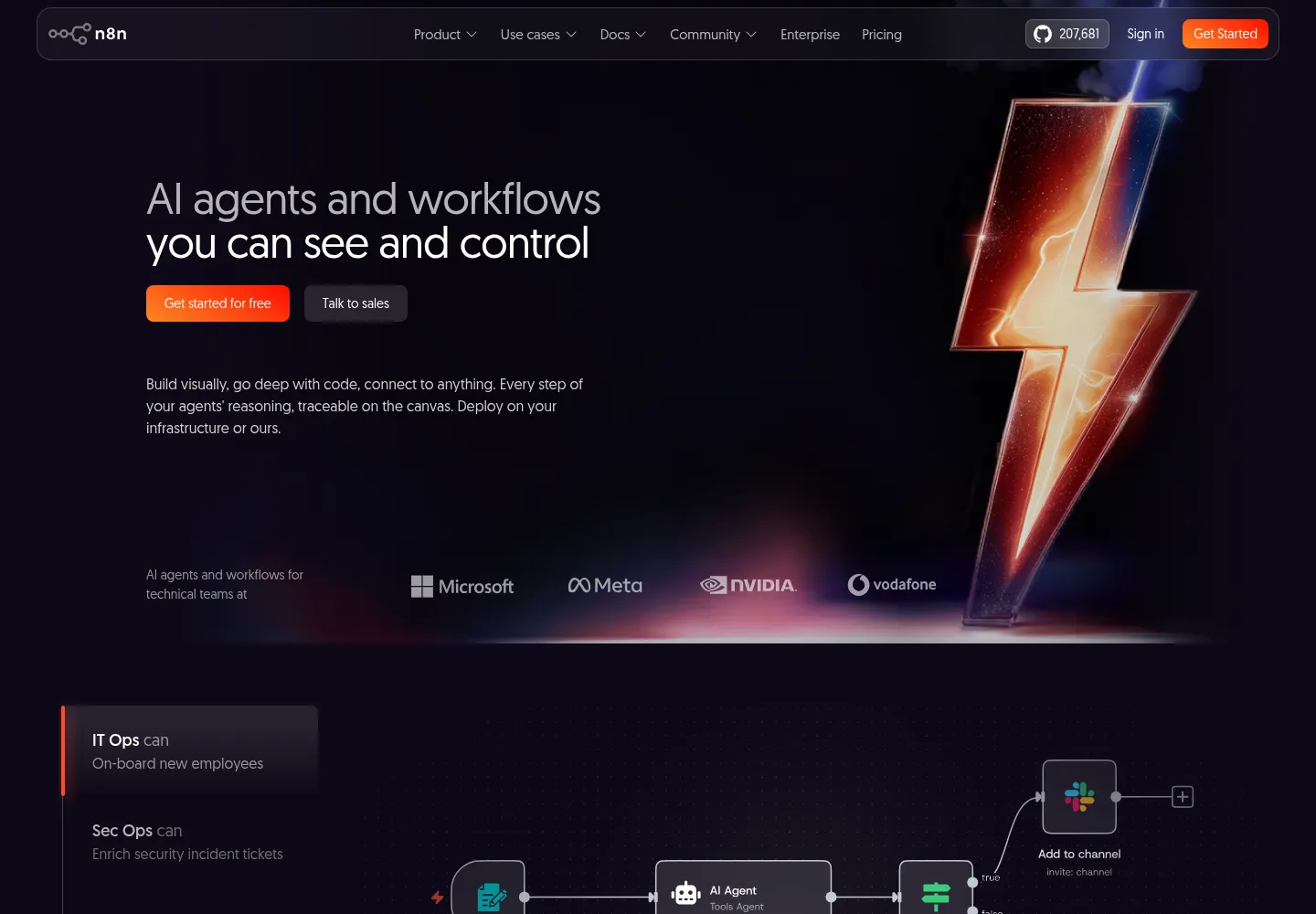
We have used n8n for a long time as an engine for our agency workflows. Its value is control: when Claude, ChatGPT or another agent is part of a business process, we still need to see what ran, what happened at each step and where something stopped.
An ad hoc conversation is useful for figuring out a task. A recurring client workflow needs triggers, integrations and a visible execution path. That is why we put n8n around processes that must work repeatedly, including research, enrichment and handoffs between tools.
The visual workflow also makes troubleshooting more practical. Instead of asking an agent to explain everything from memory, the operator can inspect the actual execution and fix the affected step.
The use cases and features that matter to us
| Use case | Feature | Why we use it |
|---|---|---|
| Run the same process repeatedly | Triggers and workflow scheduling | Start work from the business event that matters, rather than a person remembering to ask. |
| Connect research to sales tools | Native integrations and HTTP requests | Move context between the agent, data providers, CRM and outreach platform. |
| Combine AI with explicit business logic | AI nodes and branching | Use a model where interpretation helps and defined steps where the process is known. |
| Troubleshoot a stalled workflow | Execution history and error workflows | Find the failed step and recover the work with the relevant context. |
| Support different entry points | Webhook, schedule and app triggers | Let inbound requests, timed checks or tool events feed a shared process. |
Feature references: n8n workflow executions; n8n Webhook trigger.
A practical play: make account research repeatable
Here is a practical way to apply that approach to your own team:
- Start from an incoming lead, a CRM event or a scheduled account review.
- Gather the company information needed for the decision through connected research tools.
- Use an AI step to interpret that context and explicit workflow branches to decide the next action.
- Update the CRM and notify the owner, using execution history to investigate any incomplete step.
Cloud or self-hosted?
Choose n8n Cloud when your team wants the vendor to operate the platform and your requirements fit the available plan. Consider self-hosting when infrastructure location, network access or deployment control is a material requirement and you have an owner for operations.
Self-hosting shifts responsibility for updates, backups, certificates, database health and recovery to your organization. It is not automatically the cheaper choice once those responsibilities are included. Avoid treating the availability of source code as permission for every resale or hosting model; check the applicable license for your intended use.
Before selecting either route, list required environments, access roles, log retention, concurrency and recovery expectations. Then compare the exact plan. “We need n8n” is less useful than “two administrators need to safely change routing rules while sales can inspect failures.”
n8n pricing and execution planning
Reviewed October 18, 2026. The official pricing page lists Starter at €20/month billed annually for 2,500 workflow executions and Pro at €50/month billed annually for 10,000. Business is listed at €667/month billed annually with 40,000 executions and self-hosted deployment; Enterprise is custom. Plan features and limits differ. n8n defines an execution as a workflow run rather than charging for every step. Verify the selected configuration on n8n's pricing page.
Estimate from triggers, not diagram size. As an illustrative calculation, 3,000 distinct inbound events plus one daily reconciliation run produce 3,030 runs before retries and any separately billed workflow behavior. A five-minute polling schedule runs about 8,640 times in a 30-day month, even before considering what it finds. Confirm how your actual architecture is counted using usage logs.
Add connected enrichment, AI model and messaging costs, plus implementation and maintenance. An execution allowance does not include every external API subscription. Benchmark a representative sample that includes errors and retries rather than only a clean demonstration.
n8n versus Make, CRM automation and agents
Evaluate n8n when custom transformations, APIs and code are central to the process. Make is also a strong candidate for visually coordinated app workflows; compare the same sample workload under its credit model. There is no useful universal answer based only on the number of integrations.
If the process stays entirely inside one CRM and native automation already expresses the rules, start there. Introducing another platform should solve a real limitation. If the task needs open-ended research, an agent such as Hermes can prepare evidence, while n8n handles explicit routing and approved record updates.
A practical evaluation asks each option to process the same five cases: a new account, an existing customer, a duplicate submission, a provider failure and an ambiguous match. Compare reviewer effort and recovery clarity as well as the successful path.
Acceptance checks and success measures
Before launch, verify that duplicate delivery creates one business outcome, a failed enrichment preserves the lead, ownership rules are explainable and a replay does not resend notifications. Confirm the team can pause the workflow without losing incoming events and can identify records waiting during the pause.
Measure time to correct assignment, unassigned records, duplicate creation rate, exception age and human corrections. Add cost per correctly processed event. A technically successful execution rate alone can hide systematic routing mistakes.
Implementation and handover
A frontBrick implementation should deliver the workflow, field map, identity rules, credential ownership record, error procedure, acceptance cases and an operating dashboard. Your team should be able to change a territory rule and recover one failed event without rebuilding the system. Discuss your GTM automation with Stan. Implementation pricing depends on scope.
Buyer questions
Can n8n automate lead generation?
It can coordinate sourcing, enrichment and handoffs through connected tools. The source, targeting strategy and contact permissions still determine whether the resulting list is commercially useful.
Does self-hosting make every feature free?
No. Community and paid offerings differ, and running infrastructure has costs. Match governance and collaboration requirements to the current edition and license.
Can we use AI inside the workflow?
Yes, n8n supports AI-related integrations. Keep model judgments separate from deterministic business rules and test the error and review paths before allowing automatic writes.
What happens when HubSpot is unavailable?
Your design should retain the event and retry within defined limits or route it to an exception queue. That behavior must be implemented and tested; it should not be assumed from a connector's presence.
How technical does our team need to be?
Routine operation can be documented for a revenue-operations owner. Custom APIs, code, authentication and self-hosting still require technical competence somewhere in the support model.
What should we ask an n8n partner to demonstrate?
Ask for duplicate handling, a failed provider call, a partial success and a safe replay. Those cases show whether the workflow can be operated after the demo ends.