
In this guide
- Stan’s take: why Attio became our main CRM
- The use cases and features that matter to us
- A practical play: research to a sales conversation
- Sequences are a specific capability, not a blanket sending strategy
- Attio pricing and the automation cost that follows
- Attio versus HubSpot: choose around the operating model
- Implementation checks before the team relies on it
- Measure adoption and hand over ownership
- Buyer questions about Attio
Stan’s take: why Attio became our main CRM
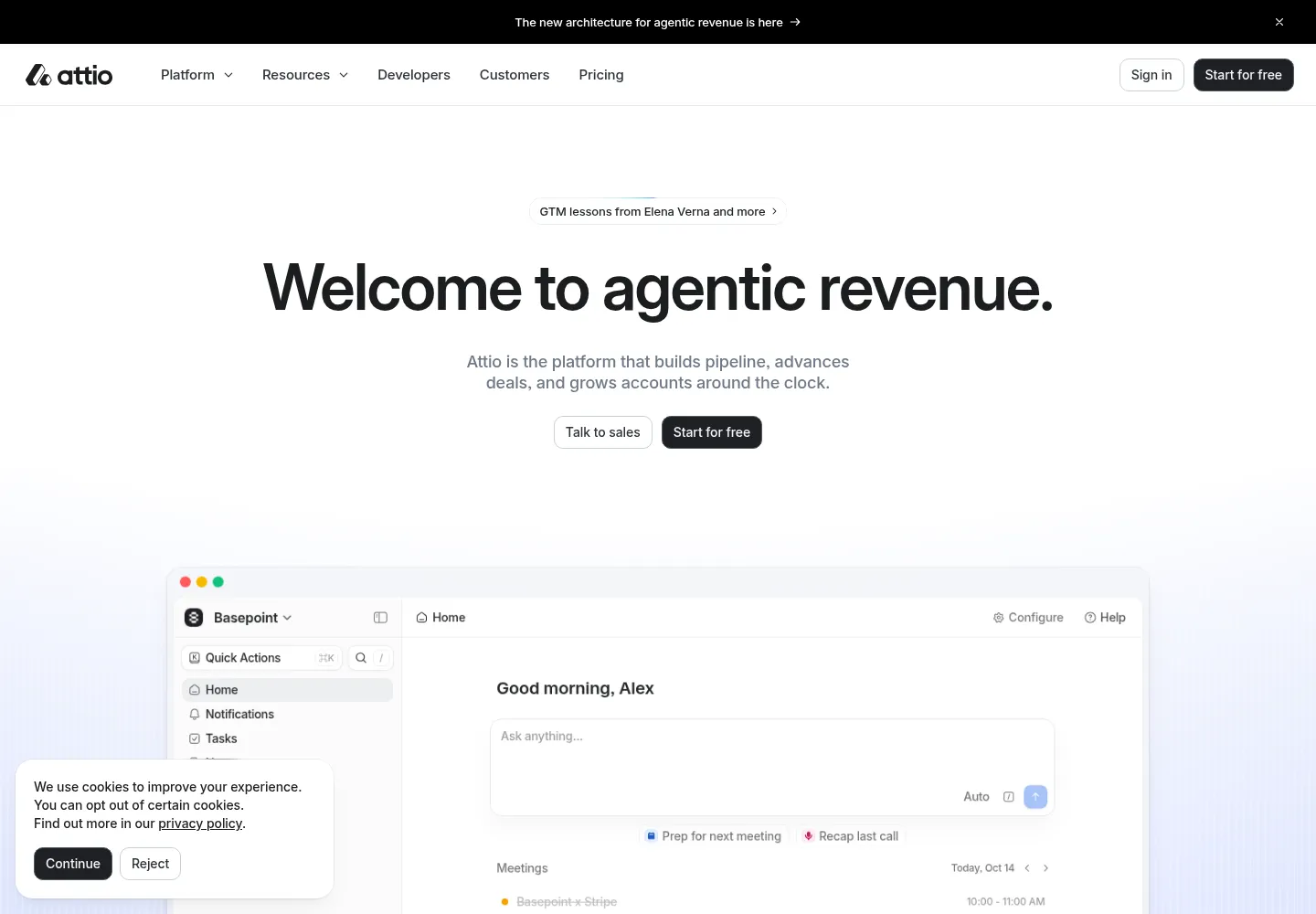
Attio is the CRM we run frontBrick on. My preference comes from using it: it feels as approachable as Notion, but with the relationships, workflows and sales context we need to run the business. For an agency building with Claude Code, ChatGPT and connected tools, that flexibility matters every day.
Since migrating from our previous CRM, our pipeline has grown to at least three times its earlier size. That is our experience over the period, not an isolated test of Attio or a promise that changing CRMs will produce the same result. What I can say is that Attio fits how we work: research, conversations and next actions are easier to keep together.
The combination I value is a usable CRM interface, Clay enrichment, Slack workflows and agent access. Sequences add another way to act on the data inside the platform. These capabilities belong in one operating system for the team, although availability and allowances still depend on the plan.
The use cases and features that matter to us
| Use case | Feature | Why we use it |
|---|---|---|
| Run an agentic sales process | MCP and assistant connections | Use CRM context in Claude Code or ChatGPT instead of repeatedly copying records into a chat. |
| Prepare accounts before outreach | Clay integration | Bring researched company and contact context back to the place sales works. |
| Keep the team moving in Slack | Ask Attio and workflow notifications | Turn a question or account update into a clear follow-up for the owner. |
| Follow up on qualified conversations | Sequences and connected email | Keep the next sales touch attached to the relationship. |
| Adapt the CRM to your business | Configurable records, relationships and views | Give the team a familiar workspace without forcing every process into the same layout. |
Feature references: Attio’s 2026 updates: MCP, Clay, Slack, ChatGPT and workflows.
A practical play: research to a sales conversation
Here is a practical way to apply that approach to your own team:
- Start from an account in Attio and decide what sales needs to know before contacting it.
- Use Clay or an approved research workflow to fill those gaps, keeping the evidence with the account.
- Let the assistant summarize the opportunity and propose a next action using the CRM context.
- Have the owner review it in the CRM or Slack, then follow up and record the response against the same account.
Sequences are a specific capability, not a blanket sending strategy
Native sequences are available on Pro and Enterprise. Attio describes them as particularly suited to existing customers and warm leads who expect communication. They support timed email steps, exit criteria, and enrollment from records, lists, or workflows. The enrollment target must ultimately resolve to a person.
For a cold acquisition program, evaluate the sending platform, recipient suitability, mailbox setup, and suppression process separately. Having a CRM sequence feature does not by itself make every prospect eligible for enrollment. A practical starting use case is following up after a requested demo or reconnecting with an existing customer.
Check field availability before writing templates. Attio’s email documentation says variables use person or company object attributes, rather than list attributes. If personalization only exists on a campaign list, decide how to map the approved value or use another delivery handoff.
Attio pricing and the automation cost that follows
The official pricing page reviewed October 18, 2026 lists Free for up to three seats, Plus at $44 per user/month monthly or $35 on annual billing, and Pro at $99 monthly or $79 on annual billing. Enterprise is custom. Plus includes 1,500 monthly workspace credits; Pro includes 10,000. Individual seat credits are a separate allowance. Check your required object, permission, and sequence features before selecting a tier.
In the new workflow billing model, triggers, logic, and data lookups are free. Actions such as data writes and task creation consume credits; AI usage varies. Legacy workflows use a different model, so identify which version your workspace is running before estimating or migrating.
For illustration, processing 1,000 leads with one data write and one task each consumes 2,000 action credits under the documented one-credit-per-action rules, before any AI or other charged steps. If the business needs only one task per qualified lead, filter earlier. Spend should follow useful outcomes rather than the number of rows entering the system.
Total cost includes seats, additional credits, enrichment providers, integration maintenance, and implementation. A lower seat bill is not a saving if the team needs a separate system to cover its core marketing or support requirements.
Attio versus HubSpot: choose around the operating model
| Decision | Attio consideration | HubSpot consideration |
|---|---|---|
| Revenue data structure | Evaluate flexible records, lists, and relationships against your process. | Evaluate the standard CRM structure and the capabilities of the hubs you buy. |
| Marketing and service scope | Map the separate tools you will retain and how their data returns. | Assess whether consolidating more functions justifies the broader subscription. |
| Automation economics | Model workspace credits, AI usage, and external providers. | Model seats, hub tiers, contacts where applicable, and onboarding. |
| Migration | Rebuild meaningful relationships and process states, not just rows. | Audit history, associations, permissions, and reporting before moving. |
Neither choice removes the need for process design. Ask both vendors to demonstrate your own difficult case: two people at one account, an existing opportunity, a new request, and a change of owner. The result should preserve context without generating duplicate work.
Implementation checks before the team relies on it
- Identity: the same incoming record twice produces one intended record and one next action.
- Ownership: an existing customer goes to its current owner, and a missing territory reaches a fallback queue.
- Permissions: users see the records and communication detail they need for their role.
- Research: contradictory enrichment does not overwrite a verified field without review.
- Automation: an attribute update does not repeatedly trigger its own write action.
- Recovery: a failed external call can be retried without duplicating enrollment or tasks.
Use a test set containing duplicates, blank values, customer accounts, active deals, and a contact who changes companies. This is more revealing than demonstrating the happy path with one clean lead. Check the outcome in the CRM and the downstream system, not only a green workflow status.
Measure adoption and hand over ownership
Track unassigned records, response time, records missing essential fields, duplicate actions, and accepted opportunities by source. For AI-assisted research, sample the accuracy of the fields the team actually uses. For workflow costs, record credits per successfully routed lead and investigate changes after a configuration update.
The handover should contain a data dictionary, source-priority rules, integration permissions, workflow diagrams, a test set, and a short recovery procedure. Name the person who approves schema changes. Otherwise each new request can create another near-duplicate field and undermine reporting.
frontBrick can design the commercial process and implement the Attio workflows around it, with documentation your team can operate. Pricing is custom to scope. Book a complimentary discovery call with Stan to map the process before buying extra software.
Buyer questions about Attio
Is Attio a replacement for HubSpot?
It can replace a CRM use case when its data model and workflows meet your requirements. It is not a like-for-like replacement for every combination of HubSpot sales, marketing, and service products. Inventory those dependencies before migrating.
Can nontechnical teams use Attio?
Yes. The important requirement is clear process ownership, not coding for every task. More complex integrations may need technical help, but everyday records, views, lists, and workflow decisions should be documented for the operating team.
What is the difference between an object and a list attribute?
An object attribute is shared across records of that type throughout the workspace. A list attribute belongs to a specific list process. Put shared account facts on the record and process-specific tracking on the relevant list.
Does Attio have email sequences?
Yes, on Pro and Enterprise. Evaluate them for appropriate follow-up, especially warm relationships. Confirm sender access, eligibility, exit conditions, and the attributes available to personalize the message.
Why can automation cost more after migration?
New and legacy workflows have different charging models, and AI consumption can vary. Recalculate the actual executed steps and run a limited comparison before switching a high-volume process.
Can Clay enrich Attio?
You can design a Clay-to-Attio enrichment workflow using the available integration or API path appropriate to your setup. Define matching keys, write permissions, freshness, and overwrite rules first. An enrichment tool should not silently become the owner of your sales-confirmed data.